
Back to subject area

MSc Advanced Computer Science

Postgraduate

Start date
Study mode
Course length
UCAS Code
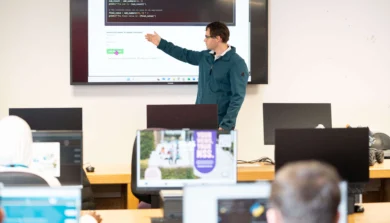
Computer Science students in class on laptop

MSc Advanced Computer Science

Discover how advanced technical knowledge, ethical insight and creative thinking can shape your future in computing. The MSc Advanced Computer Science at Birmingham Newman University is designed for graduates with a background in computing or a related discipline who are ready to take their expertise further. Whether you are looking to specialise in a technical area, enhance your career prospects or prepare for research, this course offers a supportive and intellectually stimulating environment where you can grow as a computing professional. With a strong emphasis on ethical practice, innovation and applied learning, the programme equips you to engage with cutting-edge technologies and respond to the demands of a fast-moving digital sector.

What does this course cover?
What You’ll Study and How You’ll Learn. You will explore advanced topics including artificial intelligence, machine learning, data science, cloud computing, cybersecurity and software engineering. The curriculum is informed by current industry trends and academic research, ensuring you gain both theoretical depth and practical experience. You will also build skills in project management, critical thinking and responsible computing. Learning is delivered through a blend of lectures, workshops, collaborative projects and independent study, supported by experienced academic staff who are committed to your success.
How will I be assessed?
How Will I Be Assessed?

Assessment is designed to support your growth as a confident and capable computing professional. You will complete a range of coursework-based tasks, including software development projects, technical reports, data analysis, presentations and a final research dissertation. A key component is a reflective assignment that draws on your learning journey, incorporating feedback, personal insight and practical experience. This approach helps you connect advanced theory to practice and consider how your knowledge can be applied in future study or work.

Book a free consultation

Why Study This Course?

The MSc Advanced Computer Science offers an inclusive and empowering opportunity for computing graduates to deepen their knowledge and broaden their career options. Whether you are aiming to specialise in a high-growth area, strengthen your technical capabilities or prepare for further academic study, this course provides the tools, experience and confidence to succeed in today’s competitive tech landscape. With a focus on real-world application and ethical computing, the programme supports your development as a skilled and responsible professional.

Explore the Realities of Computing in Practice.

You will engage with advanced areas such as artificial intelligence, machine learning, cloud computing, cybersecurity and software engineering. The course encourages you to think critically, solve complex problems and reflect on how technology affects individuals, organisations and society. With a strong emphasis on hands-on learning, you will work on applied projects, engage with current research and develop the skills needed to contribute effectively in a range of computing roles. Each module is designed to challenge and inspire you as you refine your expertise.

Supportive and Personalised Learning.

At Birmingham Newman University, you will be part of a close-knit academic community that values your individuality and supports your development. The course is delivered through a flexible blend of on-campus teaching and online resources, designed to fit around your personal and professional commitments. You will be taught by experienced lecturers and researchers who are passionate about computing and dedicated to helping you succeed. With small class sizes, personalised feedback and regular opportunities for one-to-one support, you will be guided every step of the way, from your first seminar to your final dissertation.

Complimentary Surface Pro

All Computer Science students set to start in 2026 will receive a Surface Pro laptop. This will be automatically loaned to you for the entire duration of your course. This exclusive, dedicated device is yours to support your studies from day one.

Complimentary Surface Pro

Got a question you’d like to ask?

Entry requirements

A relevant honours degree, 2:2 or above.

If English is not your first language, you must have an IELTS score of 6.5, with no element below 6.0. (Other English language qualifications are also accepted. Please contact admissions for further information).

Consideration will be given to applicants with lower grade in qualifications (e.g. a 3rd class degree or non-honours degree) who have a relevant range of post study professional experience. Professional experience will be considered by the programme leader in conjunction with the quality office on an individual basis.

Course fees

The tuition fee for academic year 2026/27 is: £10,250. Tuition fees for courses starting April to May 2026, fall within the 2025/26 academic cycle.

Additional costs

Computer Science News

Andrew Csizmadia

Andrew Csizmadia Named Fellow of the British Computer Society for Excellence in Computing Education

Andrew Csizmadia SFHEA, Emeritus Fellow in Computing Education at Birmingham Newman University, has been appointed…

Book an open day

Find out about our next open day. Book now to secure your place.

Distributed systems development
20 Credits (Compulsory)

This module develops the theoretical and practical knowledge of design and development of distributed systems that operate on various devices, from cloud services to servers to smartphones. The module presents concepts of models of distributed systems, inter-process communication and synchronisation, load balancing, replication and consistency, middleware and security implications, emerging trends and challenges.

Topics include asynchronous synchronous computation and/or communication, concurrency control, robustness and fault tolerance, general purpose programming with GPU, heterogeneity, interconnection topologies, load balancing, memory consistency models, memory hierarchies, message passing interface (MPI), MIMD/SIMD, multithreaded programming, parallel algorithms & architectures, performance analysis and tuning, shared or distributed memory models, scalability and scheduling. Contemporary tools such as nVidia CUDA, Amazon AWS, Microsoft Azure, OpenStack, OpenMP and Hadoop etc. are also discussed.

Dissertation
60 Credits (Compulsory)

Having studied core Computer Science topics, students have the opportunity to apply a range of conceptual knowledge and practical implementation tools to an in-depth development of a real-world project of their particular interest. The aim is to develop the skills expected at postgraduate level and equip Computer Science students with imperative knowledge, research & analysis skills, application of software development life cycle and critical insights into the process of transforming user requirements into practical software solutions.

Computer vision
20 Credits (Compulsory)

This module develops the technical perspectives and practical knowledge of computer vision and its applications. Evolving as a confluence of image processing, artificial intelligence and machine learning, this module incorporates low- and high-level feature extraction from images and videos, implementation of statistical pattern recognition and generation of predictions and semantic analyses.

Topics include image characterises, processing in spatial and frequency domains, linear transformations, wavelet decomposition, feature detection and extraction, image registration, segmentation, motion estimation, probabilistic models of object detection and recognition, object tracking, scene labelling and context and scene understanding.

The practical implementation of state-of-the-art algorithms is done using Python (or Matlab) environment with relevant libraries such as OpenCV.

Research methods & project management
20 Credits (Compulsory)

This module introduces objectives and importance of research in Computer Science, systematic literature review, problem statement and hypothesis formulation, experiment design, identifying types of variables and data wrangling, sampling techniques, quantitative and qualitative research, mixed methods of research, data imputation, types of statistical tests and evaluation measures. The module also discusses ethical constraints, intellectual property rights and legal requirements. The students are expected to conduct data analyses and present reports in a variety of formats and visualizations.

Mobile & ubiquitous computing
20 Credits (Compulsory)

This module develops the technical perspectives and practical knowledge of mobile and ubiquitous computing systems. People continuously use various devices, from cloud services to servers to smartphones, without being actively aware of their interaction with computer systems in everyday life. Ubiquitous (Pervasive) computing integrates connectivity functionalities into all of the objects in our environment for seamless interaction and automation.

The module presents concepts of advanced human-computer interaction that address cutting edge real-world problems, interaction paradigms, cognitive models, practices of developing smooth and seamless interactions, usability engineering and inspection, enhancing user experience within the subjective and objective requirements, wearable systems, activity tracking, smart homes, edge computing and discussion of emerging trends and research challenges. Furthermore, students learn concepts such as development activities, resource management within mobile devices, media services and content provision, data storage, security, managing evolution of tablets and phablets, speech sensors networking, concurrent processes and threads, deployment strategies, integration of AI on supported hardware platforms and cognitive mobile analytics.

Students will critically evaluate different architectures and frameworks for designing and developing software applications in application domains such as logistics, autonomous vehicles, home automation, e-commerce or healthcare etc. Emphasis on improving user experience, resource management, portability and interoperability. Practical programming will be done using MS Visual Studio, Eclipse, Android Studio, Xcode or similar suite.

Advanced analyses of algorithms
20 Credits (Compulsory)

This module develops the theoretical, mathematical and practical foundations of algorithms in Computer Science. The time and space trade-offs and their relation to size and nature of inputs are fundamental in all software applications of programming, databases and distributed computing, machine learning, computer vision, deep learning, natural language processing, big data analytics, cryptography and information retrieval etc.

The module aims to introduce students to an in-depth understanding of ‘best’, ‘average’ and ‘worst’ case scenarios, iteration versus recursion, backtracking, linear versus dynamic programming, greedy algorithms, self-balancing trees, topological graphs (directed and undirected, traversals, colouring, distance algorithms, spanning trees), sorting, hashing and searching algorithms. Topics covered include analysis on nature and size of inputs, asymptotic notations (Big-O, Big Ω, Big Θ, little-o, little-ω), recursion and recurrence relations, design of algorithms: brute force, divide and conquer and greedy approach, dynamic programming; elements of dynamic programming, search trees; heaps; hashing; graph algorithms, shortest paths, sparse graphs, string matching, polynomial and matrix calculations and complexity classes.

A variety of algorithms are practically implemented using Python programming language (with open-source libraries) so that upon completion of the module, students should be able to critically explain the mathematical concepts and apply algorithms appropriate to a particular situation.

Information security
20 Credits (Compulsory)

This module develops the technical perspectives and practical knowledge of information security, vulnerabilities and risks related to web applications, networks, software and mobile applications, approaches of developing and deploying effective countermeasures and ethical and legal considerations.

Topics include security design principles, security mechanisms, symmetric and asymmetric cryptography, encryption, hash functions, digital signatures, key management, stream and block ciphers, DES, message authentication, RSA, authentication and access control, software security, vulnerabilities and protections, malware detection, firewalls, NIST cyber security framework, intrusion detection, security policy formation and enforcement, risk assessment, cybercrime, laws and ethics in information security.

Our Careers team provides tailored advice, placements and workshops to help you build confidence and prepare for life after university.

Live, Learn & Belong at Birmingham Newman??

At Birmingham Newman University, you’ll enjoy the best of both worlds: a peaceful, green campus that creates the ideal setting for focused study and personal reflection, yet remains just eight miles from the vibrant city centre. As the UK’s second-largest city, Birmingham is also one of the youngest and most diverse in Europe, offering a dynamic blend of culture, innovation and opportunity. From world-renowned museums and music venues to a thriving food scene alongside a growing business and tech sector, it’s a place where creativity and ambition naturally thrive.?

Experience Birmingham: A City Full of Possibilities?

Whether you're discovering the Midlands for the first time or already know the area well, Birmingham provides a lively and inclusive environment for students. As one of the most energetic and multicultural cities in the UK, it’s a place where you can grow academically while developing personally. Its rich cultural heritage, creative energy and broad range of opportunities make it an inspiring backdrop for your university journey.?

A City That Loves Great Food?

Birmingham is a brilliant place to explore diverse culinary experiences. You might wander through the famous Balti Triangle, sample global street food at Digbeth Dining Club or enjoy a relaxed meal by the canals in Brindleyplace. The city is also home to independent cafés, vegan-friendly eateries and countless hidden gems. Whether you're grabbing a quick bite between lectures or planning an evening out, there’s always something new to discover.?

Arts, Culture and Entertainment?

The city pulses with creativity. You could catch live music at the O2 Academy, experience a world-class performance at the Birmingham Hippodrome or browse exhibitions at the Birmingham Museum and Art Gallery. Creative spaces like the Custard Factory showcase local talent while hosting events that celebrate innovation. With festivals, sporting fixtures and cultural celebrations taking place year-round, there’s never a shortage of things to enjoy.?

Simple & Convenient Travel?

Getting around Birmingham is straightforward thanks to its well-connected public transport system. Buses, trams and trains make it easy to reach campus, explore the city or travel further afield. Whether you're commuting daily or heading off for a weekend adventure, transport is both accessible and affordable.?

Life Beyond the Lecture Hall?

Your time at Birmingham Newman University extends far beyond academic study. You’ll have the chance to join student societies, contribute to community projects or try something entirely new. The university’s supportive atmosphere encourages you to build confidence, develop practical skills and feel genuinely at home throughout your studies.?

Where This Course Can Take You. Graduates of this programme are well prepared to progress into specialist roles across the tech industry or continue into doctoral-level research. You will be equipped to work in areas such as software development, AI engineering, cybersecurity, cloud architecture and data analysis. The course also supports your development as a reflective and ethical practitioner, ready to lead technical projects and contribute to innovation in computing. Whether you are advancing in your current role or exploring new opportunities, this degree provides a strong foundation for a future in advanced computing.

Accreditations and Exemptions

The MSc Advanced Computer Science is grounded in the values of ethical computing, technical excellence and applied learning. Although it is not currently accredited by a professional computing body, the course is built around current industry needs and academic standards. It introduces you to the expectations and responsibilities of advanced computing professionals and provides a strong foundation for further training or doctoral-level research. Many students go on to work in specialist roles across the tech sector or pursue academic careers. The skills and insight you gain can also support your development in leadership, innovation and strategic technology roles.

Courses we think you'll also like

Instagram does not support direct link sharing, below is the page URL to copy to add to Instagram posts manually: